
Highland Projected Versus Actual Release
A projected date is a calculation or eligibility point based on the information then in the record. Actual release is the completed custody event. ODRC combines two ideas in the field “Expected Release Date/Parole Eligibility Date” and defines it as a projected release date or a date pending parole consideration. The slash matters. A parole-eligibility date can lead to review rather than release.
A Highland County pretrial detainee has no sentence-completion date. Bond, dismissal, a later plea, sentencing, and new holds can all affect when custody ends. If the Common Pleas docket shows a state prison sentence, disappearance from the county roster is normally a transfer to ODRC, not community release. A sentenced local inmate may have a computed date, but Highland publishes no public jail good-time calculator.
Final discharge is later still when parole, post-release control, or probation continues. The release date and supervision end date answer different public-record questions.
Find Highland Projected Release Dates
Use the record kept by the authority that computes the term. ODRC covers state prisoners and APA-supervised people, not someone whose only stay was at the Highland County Justice Center. The county jail and sentencing court are the local route. Federal sentenced prisoners use BOP, and an immigration transfer does not create an Ohio prison date.
- Read the court docket to determine whether the person is pretrial, locally sentenced, or committed to ODRC.
- For state prison, open the ODRC Offender Search. Search by last name or the complete ODRC number.
- Match the offender number, identity, sentence, offenses, and docket. Read “Expected Release Date/Parole Eligibility Date” without shortening its meaning.
- For a local jail sentence, ask Highland corrections or Records for the commitment, jail-time credit, scheduled date, and recorded adjustments.
- Check for detainers, court changes, parole decisions, or transfers, then confirm the completed release through the responsible record.
ODRC search filters include Incarcerated, Released, APA Supervision, and Violators at Large. County of Commitment = Highland means a sentencing connection, not a current home address. The detail may also show admission, sentence, hearing data, release/parole detail, and supervision expiration. The Highland County release-record path covers the separate sheriff and court proof needed after a county stay.
The official definitions view shown below preserves ODRC's date labels.
Read the ODRC search definitions before treating a date as a promised exit.
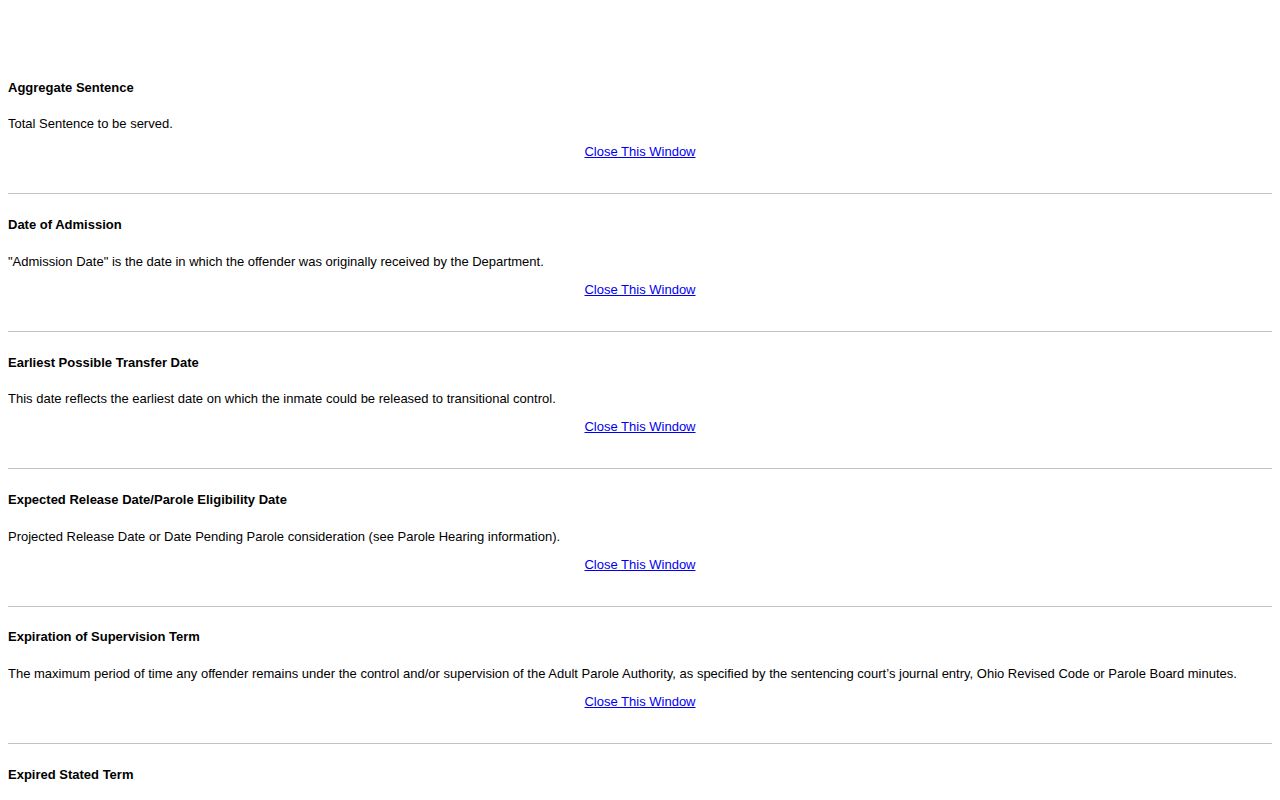
The definitions distinguish projected release, parole review, transfer, and supervision fields that can appear near one another.
Ohio Credit for Highland Sentences
Ohio does not have one safe “serve 85 percent” formula for every prison term. The calculation depends on offense and confinement dates, sentence type, mandatory or nonreducible time, jail-time credit, earned-credit eligibility, judicial release, transitional control, and ODRC or court decisions. Modern definite terms are generally not reduced without legal authority. Older indefinite and life sentences use different parole and credit rules.
ORC 2967.194 governs current earned credit for people confined on or after April 4, 2024. Eligible participation can provisionally earn one or five days for a completed month, with up to five more days for a second activity. Separate completion awards and statutory exceptions exist. The aggregate 15-percent cap applies to specified credit categories, not as a command that all people leave after 85 percent. Mandatory time and listed offenses or sentence classes can be excluded, and credit can be denied or withdrawn for rule violations.
ORC 2967.193 governs the earlier framework. ORC 2967.191 addresses qualifying confinement before state sentence. ORC 2929.20 covers judicial release, and ORC 2967.26 covers transitional control. Each provision changes a different part of the path, so the live law for the exact sentence date must be checked.
Old-law indefinite sentences use a distinct good-time and parole framework. ODRC's Bureau of Sentence Computation applies ORC 2967.13, ORC 2967.191, and the credit law tied to the sentence. An old-law concurrent indefinite minimum may receive old good-behavior reductions, while some later life eligibility terms may be reduced only by jail-time credit. One online formula cannot reconcile those sentence generations.
Note: A percentage estimate cannot replace ODRC sentence computation or the court's actual judgment and jail-credit entry.
Why Highland Release Dates Change
A date can move because the record or legal authority changes. Some changes reduce the term, while others delay departure or turn a county exit into transfer. The current ODRC field should be checked again near the expected date.
Sentence data also requires identity checks. Compare the ODRC number, aliases, offense and docket information, admission date, and aggregate sentence. ODRC cautions that its public sentence list may not be complete and that supervision can stem from a prior offense. A same-name record or one matching only Highland County of Commitment is not enough.
| Factor | Possible effect |
|---|---|
| Jail-time credit correction | Changes qualifying time credited before sentence |
| Earned credit | May reduce eligible time; denial, loss, or restoration changes the total |
| Mandatory term or specification | Blocks reduction for time the law makes nonreducible |
| Consecutive or concurrent clarification | Changes how multiple terms combine |
| Parole decision | A grant, denial, continuance, or later review affects eligible cases |
| Judicial release or court order | May authorize an earlier community-supervision path |
| Detainer or new hold | Can produce transfer or continued custody after one term ends |
A favorable parole recommendation is not the same as physical release and can be reviewed through release day. “Earliest Possible Transfer Date,” “POA,” and “TC/TT Sentence Expiration” are distinct ODRC terms. None should be relabeled as final discharge.
Confirm Highland Actual Release Dates
For a state prisoner, compare the ODRC status and Parole or Release Detail after the projected day. “APA Supervision” can establish that prison custody ended under departmental supervision, but the displayed residential address may lag. For a Highland jail sentence, ask the sheriff for the existing booking/release record and read the responsible court's journal entry. The court supplies legal authority; the jail record supplies physical release time.
Register before departure through the Highland County VINELink check. A General Release event is relevant, while Transfer means custody continued elsewhere. VINE is notice, not a certified document. A person leaving the county jail for ODRC, BOP, ICE, another jail, or treatment placement has left the roster but may not have entered the community.
Older dates may require a sheriff records request, an ODRC released search, and the court case. Central Records at P.O. Box 430, Columbus, OH 43216 is the ODRC route identified on detail records for agency data questions.
Highland has three local court paths. Common Pleas supplies felony sentencing and ODRC-conveyance entries. Hillsboro Municipal covers its municipal and misdemeanor docket plus preliminary stages, but its public data may trail through the prior business day and does not update on weekends or legal holidays. Highland County Court in Greenfield is a separate lower-level case source. The correct clerk can provide the filed journal entry when the web summary is unclear.
A request to sheriff Records should seek existing fields, not ask staff to create a new calculation. Useful items include the commitment, booking date, court, jail-time credit, scheduled release field, later adjustments, and hold or transfer notation. No published Highland rule sets a general release hour, weekend advance date, or family waiting point. Confirm operations with the jail at 937-840-6240.
Highland ODRC Date Labels
ODRC's combined “Expected Release Date/Parole Eligibility Date” is Highland County's key state-prison lookup field, but it is not the only date on a detail page. The system separately identifies parole consideration, earliest transfer, POA, transitional-control expiration, release detail, and supervision end. The safest interpretation keeps each official label intact.
Old-law indefinite terms can reach Parole Board review after a minimum adjusted under the rules that apply to that sentence. Modern terms may end by expiration subject to valid credit and control. Reagan Tokes indefinite terms under ORC 2967.271 carry a presumption of release at the minimum or presumptive earned early release point, which ODRC may rebut after a statutory hearing. That presumption is not an old-law parole grant and not a guaranteed calendar exit.
Search the individual record, not a countywide estimate. Highland County has no adult ODRC prison, so the statewide result follows the person wherever ODRC places them.
ORC 5120.66 requires the ODRC Internet database and calls for at least daily updates to prescribed information, including relevant release and parole dates and notices. That cadence does not turn a projected field into a guarantee. A new court order, sentence recalculation, or custody event can still change the record.
Highland Jail Release Calculations
Local misdemeanor sentences follow the court judgment and applicable jail-credit rules. ORC 2929.24 sets maximum definite jail terms by misdemeanor degree. ORC 2949.08 directs the conviction record to specify qualifying related confinement and requires the jailer to reduce the imposed jail term accordingly. More than eight hours of confinement in a calendar day counts as a day under that provision.
ORC 2947.151 permits, but does not require, a sheriff with written judicial concurrence to award limited work-related reductions at statutory rates. No Highland source confirmed adoption or routine use. It must be raised as a question for jail staff, never promised as local credit. Likewise, no Highland release-time, early-weekend, or holiday policy was verified. Ohio research found no statewide rule that moves every Sunday release to Friday.
ORC 2949.12 generally calls for the sheriff to convey a state-sentenced felon to ODRC reception within five days after sentencing, excluding weekends and holidays, subject to the statute. That explains why a Highland roster entry can disappear soon after a Common Pleas prison sentence. The event is a state transfer, so ODRC becomes the correct projected-date source.
Local jail release and state-prison discharge must not be blended. A bond order can end a county jail stay while the case remains pending. Time served can satisfy the local term while another warrant keeps the person in custody. State release can begin APA supervision, and the later Supervision End Date or Early Termination field is proof of discharge from that control.