
Highland Parole Versus Probation
A Highland County release can lead to several forms of supervision. They are not interchangeable. Parole mainly concerns eligible old-law, indefinite, or life sentences and follows an Ohio Parole Board decision. Post-release control follows specified prison terms under Ohio law. Judicial release occurs when the sentencing court releases a state prisoner under court-ordered supervision. Probation, commonly called community control in Ohio court records, is imposed by a court and can follow a local jail term without any ODRC prison stay.
| Supervision | Who orders it | Where to verify it |
|---|---|---|
| Parole | Ohio Parole Board for an eligible sentence | ODRC Offender Search and parole/release detail |
| Post-release control | Applies after qualifying state prison terms | ODRC APA Supervision record |
| Judicial release | Sentencing court | ODRC status plus the court's journal entry |
| Probation or community control | Common Pleas, Municipal, or County Court | The sentencing docket and named probation department |
These paths also end differently. Leaving prison starts many APA obligations; it does not end them. A local jail discharge may begin court probation. The later ODRC supervision-end field or court termination entry is the proof that control ended. The Highland County released-inmate search path helps establish the earlier custody exit before supervision is checked.
- Parole
- Conditional release from an eligible prison sentence under Parole Board authority.
- Probation
- Court-ordered community supervision, often labeled community control in Ohio.
- Discharge
- The formal end of a supervision duty, distinct from leaving jail or prison.
- Absconder
- A person alleged to have stopped complying with supervision or reporting requirements.
Verify Highland Post-Release Supervision
Begin with the source that controlled the sentence. ODRC covers people received into state prison and those later supervised by the Ohio Adult Parole Authority. It does not replace a Highland County court probation record. The official search permits APA Supervision and Violators at Large filters, while Residential County can be set to Highland for those two status groups. ODRC warns that the address is the last reported address and may lag.
- Open the ODRC Offender Search. Search by last name, or use the full ODRC number when known.
- Select APA Supervision. Use Residential County = Highland only as a narrowing tool, then compare the offender number, name, sentence, and docket data.
- Read the full status and supervision detail. “Released,” “APA Supervision,” “Judicial Release,” and “Violator at Large” do not mean the same thing.
- If there was no state prison term, open the sentencing court docket. Check later entries for community control, revocation, termination, or discharge.
- Confirm the current office and reporting terms with APA or the probation department named in the order. Do not rely on an old address alone.
Highland felony matters generally run through Common Pleas. Hillsboro Municipal handles municipal and misdemeanor matters and preliminary stages, while Highland County Court in Greenfield is a separate local path. The docket identifies the court act. It may not show the exact time the jail physically released the person.
Note: County of Commitment means sentencing county; Residential County means the last reported APA or VAL address, not a verified present location.
Highland APA Office Verification
A 2023 Highland Community Resource Directory identifies an APA Hillsboro office, but no current ODRC field-office page confirmed public hours during research. Treat the location as a lead. Phone first before using it as a walk-in destination. The official conditions of supervision state that a released person is to report in person to the supervising officer on the next business day, so the individual's official record and release instructions control.
APA Hillsboro office, directory listing100 S. High Street
Hillsboro, OH
937-393-8401
Hours not verified; call before visiting.
The Ohio Adult Parole Authority oversees state supervision. The Ohio Parole Board is a separate decision-making body within ODRC. For county-court probation, contact the department named in the sentencing or supervision order rather than assuming APA controls the case.
The official APA page shown below provides the statewide starting point for supervision information.
View the Ohio Adult Parole Authority source before relying on a local directory listing.
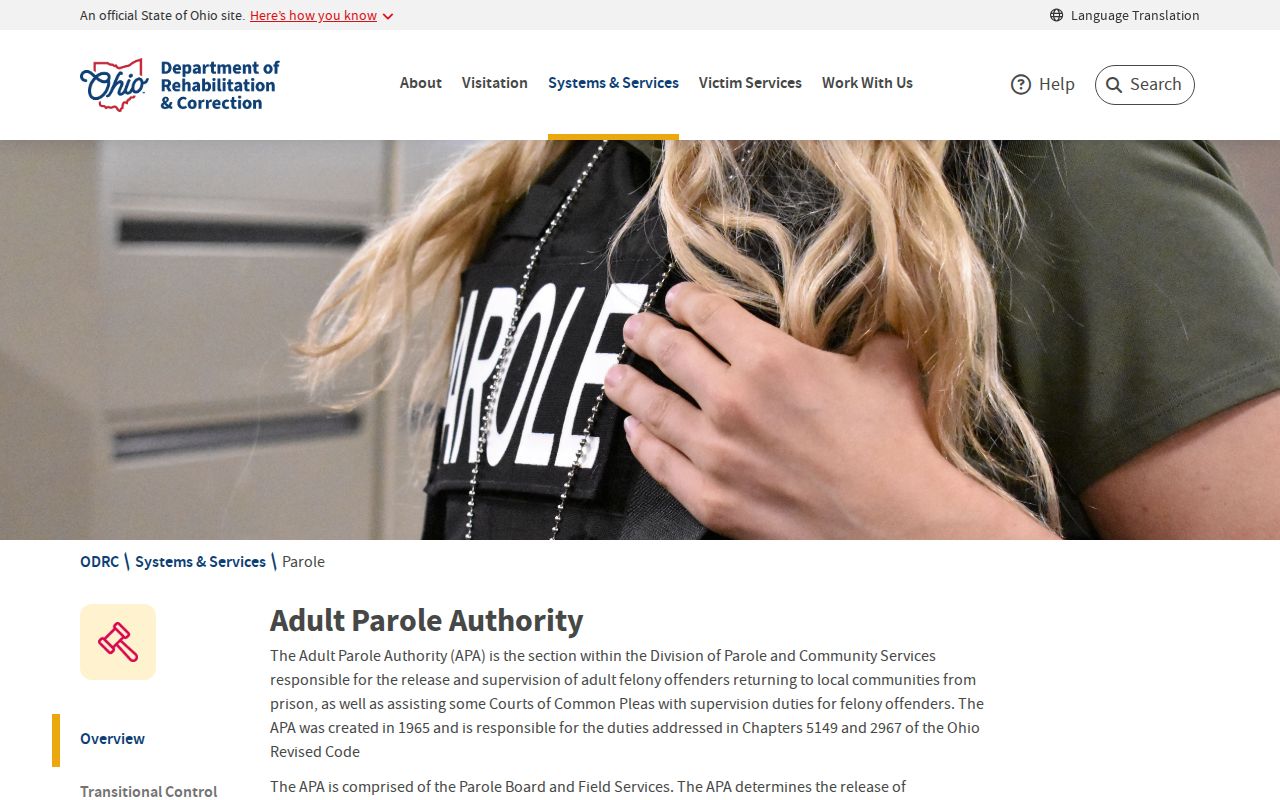
Use the matching ODRC result to identify the office connected with the person, then confirm instructions directly.
Highland Supervision Violations and Warrants
Supervision conditions are the rules a released person must follow. The official ODRC conditions document includes the next-business-day reporting direction. Other terms depend on the sentence and order. A suspected violation may lead to investigation, a warrant, a hearing, or a return to custody, but a public status alone does not prove a new offense or conviction.
The ODRC Violators at Large, or VAL, path is the state channel for alleged APA absconders. Its displayed residential information is the last recorded address before absconding. The Highland County Sheriff's Most Wanted page is a separate county warrant source. Research found that the sheriff warned its list changes through routine updates and was being updated at the time. Neither source should be treated as a live location.
If a status appears wrong, compare the ODRC number and docket before contacting the agency. A person can have supervision tied to a prior offense, and the public sentence list may be incomplete. A VAL label describes an alleged supervision lapse. It does not erase the earlier prison release, prove a new charge, or show the person's present address.
Ohio VINE can send some ODRC parole-related events, including parole revocation or return to prison and release from parole. A VINE alert is useful notice, but the ODRC detail and official order remain the better status record.
Highland Parole Hearing Records
The Ohio Parole Board conducts statewide release consideration for eligible cases. It does not hold a separate Highland County calendar. The ODRC search accepts a Next Parole Board Hearing Date in YYYYMM format, and an individual detail can show the next review month plus the latest hearing or review type and result. The Board Handbook explains that cases appear on monthly call sheets and follow case-specific review steps.
A scheduled month is not a release date. Results may grant release, deny it, continue review to a later date, or defer action while more information is gathered. The wording in the person's record or official minutes should be preserved. ODRC notes that the board generally reviews a case before the displayed eligibility date so a decision can be made in advance, yet a favorable outcome can still be reviewed through the day of release.
The Ohio Parole Board Handbook lists the board at 4545 Fisher Road, Suite D, Columbus, OH 43228, with 614-752-1200 and 888-344-1441. ORC 2967.13 and the law that applied when the sentence arose govern eligibility. Modern definite terms commonly end through expiration and applicable control rather than a discretionary parole grant.
Note: Read the individual ODRC result for the current hearing month because older indexed schedule pages may no longer be live.
How Highland Supervision Ends
Release from a facility, release to the community, and final discharge are three separate events. ORC 2967.28 governs post-release control. Its duration depends on the felony level, offense type, and sentencing framework. For parole, Ohio Administrative Code 5120:1-1-13 permits a faithful parolee to be recommended for final release, generally not earlier than one year unless the maximum term expires sooner. Special timing applies to life-minimum cases.
Use ODRC's Supervision End Date or Early Termination field, or a formal final-release record, to confirm the end of APA control. For Highland court probation, look for a termination or discharge journal entry. The original prison or jail release date is not enough if supervision, restitution, or other court duties continued after custody.
Note: A favorable parole recommendation can still be reviewed or stopped through release day and is not proof of physical departure.
Correcting Highland Supervision Records
Highland County maintains a dedicated Records Center & Archives at 133 North Beech Street in Hillsboro. That does not mean the archive holds every custody or supervision file. For an old or incorrect record, first ask the office that created it whether that office still holds the series. A sheriff booking record belongs first with sheriff Records, an ODRC supervision field with ODRC, and a probation order with the issuing court clerk.
If the county record series was transferred, the Highland County Records Center & Archives can help identify access. Ask for the existing record and state the field believed to be wrong. A correction request should not be sent to an archive merely because the event is old.
Three local court routes may matter. Common Pleas handles felony cases. Hillsboro Municipal handles municipal and misdemeanor matters plus preliminary stages, and its online data runs only through the prior business day. Highland County Court in Greenfield is another path for lower-level cases outside the Hillsboro jurisdiction. When ODRC has no record, identify the arrest location and sentencing court before concluding that probation does not exist.