
ODRC Releases for Highland Cases
A Highland County defendant enters state custody only after commitment to the Ohio Department of Rehabilitation and Correction. Leaving the Highland County Justice Center for ODRC is a transfer, not release to the community. Placement is made by ODRC and can change, so a current statewide result is more reliable than an assumed prison name. The county roster no longer answers the custody question once ODRC receives the person.
Later release from an ODRC institution may lead to the community with Ohio Adult Parole Authority supervision, judicial release ordered by the sentencing court, transitional control, or expiration of a prison term. The ODRC detail record uses separate fields for status, release or parole detail, and supervision. A person can leave prison while still owing post-release control or parole. Final discharge is the later end of that legal duty.
The Highland County released-inmate search explains the county record needed before state transfer. Once a Common Pleas entry shows prison commitment, the ODRC record becomes the controlling public search route for state custody and state-prison release.
Note: County release and state-prison release are separate events, even when both records arise from the same Highland County case.
Confirm an ODRC Release
The ODRC Offender Search accepts a name or state offender number. Begin with fewer fields because ODRC advises that broad name criteria can work better. A last-name entry also returns names that begin with the same text and suffix variants. The ODRC number contains an A, R, or W prefix and six digits, with a possible leading zero for some W numbers.
- Search the last name, then add the first name only when the result set needs to be narrowed.
- Use County of Commitment = Highland to find a sentencing connection, while remembering that this is not a residence field.
- Run the relevant status filters: Incarcerated, Released, APA Supervision, and Violators at Large.
- Open the matching detail and compare the offender number, aliases, sentence, offenses, and docket data.
- For a completed prison exit, read the full status together with Parole or Release Detail. Do not rely on the expected date alone.
Release proof: ODRC status plus the Parole or Release Detail supports a state-prison release finding. An expected date by itself is not proof that release occurred.
APA Supervision confirms that prison custody ended while departmental supervision continues. Judicial Release means the sentencing court authorized community supervision under Ohio law. A Violator at Large result means ODRC alleges that a person previously released under APA control has absconded. It does not erase the prior prison release and must not be presented as a new conviction.
ODRC Release Record Fields
The matching ODRC detail can contain much more than a single status word. Identity and sentence fields help prevent a false match. Release and supervision fields show which stage of the state process has been reached. ODRC also warns that a listed sentence may not be complete and that displayed supervision can arise from an earlier offense.
| Field | What it establishes | Important limit |
|---|---|---|
| ODRC number and identifiers | Connect the result to the correct state record. | Names and aliases still require comparison. |
| Status | Shows Incarcerated, Released, APA Supervision, or VAL placement. | The full qualifier must be preserved. |
| Admission and institution | Shows entry to ODRC and current or recorded placement. | Institution placement can change. |
| Expected Release Date/Parole Eligibility Date | Shows a projected term date or parole-review point. | It is not always a promised exit. |
| Parole or Release Detail | Records the state release or parole event when present. | No detail appears while the person remains incarcerated. |
| Supervision end or expiration | Addresses the later end of APA control. | It differs from the prison gate date. |
The ODRC definitions page explains the release-date labels used on public records. Its successful manifest capture shows the official terminology without displaying a private person's individual result.
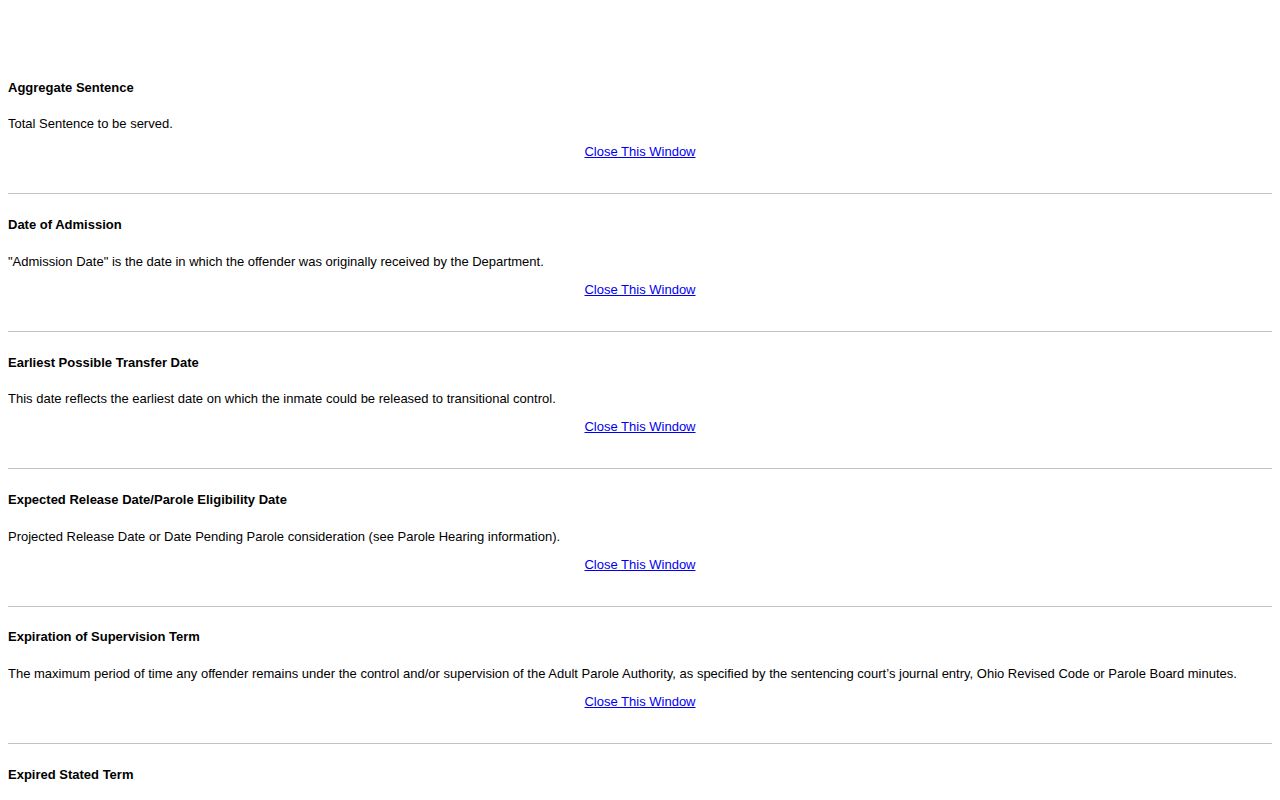
Using the agency's exact label keeps a parole-eligibility date, expected date, transfer point, and final discharge from being treated as the same event.
Highland ODRC Dates Differ
“Expected Release Date/Parole Eligibility Date” combines two concepts. It can describe the projected end of a definite term or the point when an eligible person reaches parole consideration. A hearing month is also not a release date. The individual result may show a Next Parole Board Hearing/Review Month and the latest hearing type or result, but a favorable recommendation can still be reviewed before physical release.
Dates may change when sentence credit is corrected, consecutive and concurrent terms are clarified, eligible credit is earned or withdrawn, a mandatory term applies, the Parole Board continues a case, a court grants judicial release, transitional control begins, or another hold appears. “Earliest Possible Transfer Date,” “POA,” and “TC/TT Sentence Expiration” are distinct ODRC terms. None should be renamed as the final discharge date.
Ohio's rules cannot be reduced to a promise that each prisoner serves a fixed percentage. The current earned-credit framework, sentence era, mandatory terms, jail-time credit, offense exclusions, and case-specific decisions all matter. The public ODRC field and the actual sentence record are more sound than a simple calendar estimate.
Note: Check the live Ohio Code and the current ODRC record because sentence-credit law and individual calculations can change.
ODRC Release Versus Discharge
Physical release from an Ohio prison can begin a period of parole or post-release control. Parole applies chiefly to eligible old-law, indefinite, or life sentences and follows a Parole Board decision. Post-release control is a form of supervision after specified prison terms. Judicial release is ordered by the sentencing court. Each differs from ordinary county-court probation or community control.
- APA Supervision
- An ODRC status showing that the person is no longer incarcerated but remains under Adult Parole Authority control.
- Parole
- Conditional release for an eligible sentence after action by the Ohio Parole Board.
- Post-release control
- State supervision that begins after release from specified prison terms.
- Final discharge
- The end of the remaining supervision duty, which is later than physical release in many cases.
ODRC's residential-county field works only for APA Supervision and VAL searches and reports the last recorded address. A Highland value does not prove a current home or supervising office. Verify reporting instructions through the official individual record or ODRC rather than using an old directory entry as a walk-in direction.
ODRC Records and Contact
The public offender search is the first contact point for release status. Questions about the data and narrow requests for state release facts go to ODRC Central Records. The research identifies its mailing address but does not supply a verified public counter schedule or direct phone number, so none should be inferred.
Ohio Department of Rehabilitation and Correction
Central Records
P.O. Box 430
Columbus, OH 43216
Access: statewide Offender Search and written records route
Ohio Revised Code 5120.21 describes the institutional record, including discharge terms, but does not make the entire file public. It permits disclosure of stated categories such as name, convictions, photograph, supervision status, and current or past place of incarceration. Identify the ODRC number and ask for the legally disclosable release-status fields rather than demanding the full file.
For the legal basis of a Highland County prison commitment or judicial release, obtain the filed journal entry through the Highland County Common Pleas record route. The court record explains the order. ODRC records the state custody and release stage.
Highland Jail Names Before Transfer
The local transfer path uses two names for the same county corrections channel. The sheriff calls it the Highland County Justice Center, while the regional provider row calls it Highland County Jail. A person sentenced to state prison may disappear under either local label before appearing in ODRC custody. Those names do not identify two separate Highland facilities.
The sheriff's Corrections Division page links the Justice Center to the regional jail roster. If a Common Pleas commitment appears, use that local booking and court case to match the later ODRC number. A local “release” to ODRC remains a transfer until the state record later shows an actual prison release.
Note: Match both Highland jail names to the same booking before following the person into the statewide ODRC record.
State Prison and County Release
The state and county systems answer different questions. Using the Highland roster for a state prisoner can create a false release conclusion, while using ODRC for a person who served only local jail time will produce no relevant state record.
| Custody stage | Correct source | Result to seek |
|---|---|---|
| Held at Highland County Jail | Regional current roster and sheriff records | Current listing or county booking/release record |
| Sentenced to Ohio prison | Common Pleas entry and ODRC search | Commitment, admission, institution, and status |
| Released from Ohio prison | ODRC detail | Full status plus Parole or Release Detail |
| Under APA control | ODRC APA Supervision result | Supervision status, period, and official office detail |
| Finished supervision | ODRC end-date field or formal discharge record | Supervision End Date, Early Termination, or final-release record |
No adult ODRC prison was found physically in Highland County. That absence is important. The correct result is statewide, and a facility assignment should never be guessed from the county of conviction.