
Understanding Highland County Releases
A Highland County release is the end of one agency's custody, but it is not always freedom from all custody. The Highland County Justice Center may release someone to the community after bond, a court order, time served, or completion of a local sentence. It may instead transfer that person to the Ohio Department of Rehabilitation and Correction, another jail, federal authorities, immigration custody, or a treatment placement. Each result calls for different proof. The sheriff's booking and release record documents the local exit. A court entry states the legal authority. A receiving agency's locator shows continued custody elsewhere.
Highland County released inmates normally disappear from the public jail roster because that roster is built for people held now. Removal is only a clue. It does not state the release type, exact time, destination, or later supervision. The most sound result joins a named person's record, the right agency, and the right date. A release from the jail, a release from state prison, and final discharge from supervision are separate events.
- Release
- Departure from one facility or agency, either to the community or to another authority.
- Discharge
- The end of a sentence or supervision duty, which may occur well after physical release.
- Time served
- A release based on custody time credited toward the ordered jail term.
- Detainer
- A request or hold that may send a person to another agency instead of the community.
Highland County Release Types
The release label determines what should be checked next. Bond and own-recognizance release return a person to the community while the case remains open. Neither label means dismissal or acquittal. Time served or sentence complete links the exit to custody already satisfied, subject to any other hold. A court order or dismissal may authorize release in one case while another case still controls custody.
| Release type | Meaning | Next record |
|---|---|---|
| Bond or recognizance | Pretrial release; the charge remains pending unless the docket says otherwise. | Local court docket and sheriff release record |
| Time served or sentence complete | The ordered local custody time has been met. | Judgment entry, jail-time credit, and release time |
| Dismissal or court order | A judge has entered an order affecting custody in that case. | Filed journal entry plus jail discharge data |
| State or federal transfer | The person left the Highland jail but remains in custody. | ODRC, BOP, federal docket, or receiving jail |
| Immigration hold | The local jail exit may lead into ICE custody. | ICE locator and agency confirmation |
| Parole or supervised release | Prison custody ended while a supervision term began or continued. | ODRC release detail and supervision fields |
Death can also end a custody status, but it must not be reported as an ordinary release. Likewise, transfer does not mean release to the community. Highland County release records should retain the agency's own label so those very different events are not collapsed into one vague result.
Does a bond release close the case? No. It changes custody while the case proceeds. Read the latest court entry for dismissal, plea, sentence, or another disposition.
Highland County Release Record Fields
A Highland County jail release is usually stored within the booking or jail-management record, not issued as a stand-alone public certificate. A focused request should identify the person and booking, then name the existing fields needed. That helps the Records Office locate a responsive record without being asked to write a new account of where the person went.
| Field | What it shows |
|---|---|
| Name and jail identifier | Connects the release to the correct booking and helps separate similar names. |
| Booking agency and time | Identifies who brought the person in and when the jail stay began. |
| Charge, case, and court | Connects the custody event to the legal file without proving conviction. |
| Bond type and amount | Shows the bond data maintained for that booking. |
| Release date and time | Records when the Highland County jail stay ended. |
| Release type or disposition | Distinguishes bond, time served, court order, transfer, and other outcomes. |
| Releasing authority | Identifies the office or order tied to departure. |
| Hold or destination | May show continued custody or transfer when that field is public and maintained. |
A booking photo may be part of the same retained record. Availability and redaction depend on the record and applicable law. The public roster does not publish a post-release retention period, so its display window must not be confused with official retention. The sheriff's underlying files and Ohio retention rules control the durable record.
Request Highland County Release Records
The Highland County Sheriff's Records Office accepts requests by phone or walk-in. It is at 130 Homestead Drive in Hillsboro, and its direct line is 937-393-1421, option 2. Published hours are Monday through Friday from 8:00 a.m. to 5:00 p.m. and Saturday from 8:00 a.m. to noon. No appointment is required for a walk-in. No dedicated online jail-release form, request email, or fixed response time was found.
- Gather the full name, aliases, date of birth if known, approximate booking and release dates, and booking number if available.
- Ask for the existing booking and release record. Name the release time, type, authority, bond, hold, transfer, and photo fields needed.
- For a date range, request an existing release log, export, or report for exact start and end dates. Do not demand a new custom list.
- Choose inspection or electronic delivery. Ask the office to confirm any cost before copies or media are prepared.
- If material is withheld or redacted, ask for the legal authority and for all nonexempt portions.
The sheriff states that copies of sheriff reports are provided without charge. That statement does not prove that every jail export, photo, or delivery medium is free. The published body-camera rate applies only to body-camera footage and must not be used as a release-record fee. Ohio law calls for prompt preparation within a reasonable period, but Highland County publishes no guaranteed turnaround for this record.
The official Highland County records page shows the request channels and office policy. The captured page below provides a visual check of that route.
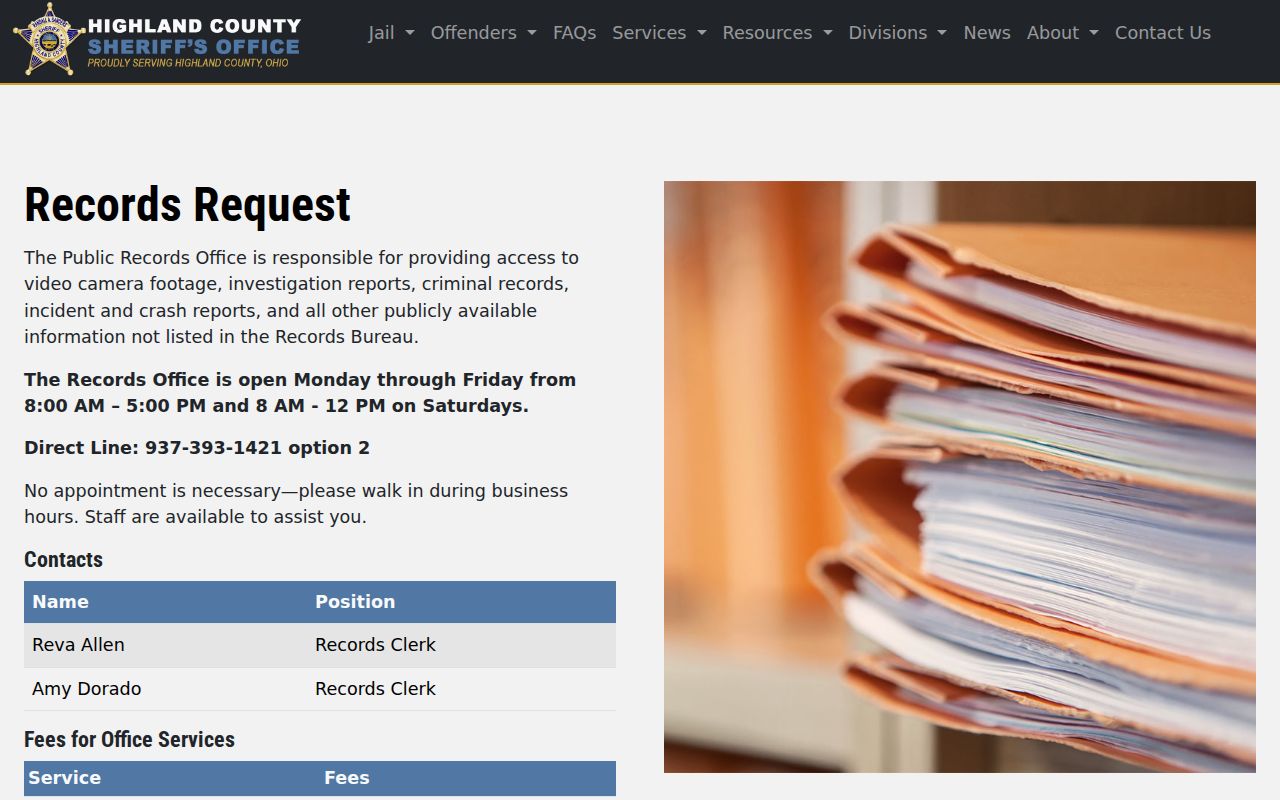
This sheriff source is the key fallback when a released name has already left the current-custody roster.
Note: Ask for records that already exist and define the booking or date range closely enough for staff to identify them.
Highland County Release Record Law
Ohio Revised Code 149.43 governs requests for public records held by Ohio offices. It requires responsive public records to be made available, subject to stated exceptions and other law. A custodian may redact exempt content while producing the rest and should identify the legal basis for a denial. The law reaches existing records. It does not require the sheriff to answer a set of questions or create a 24-hour or 72-hour release report that is not maintained.
Record scope matters. Juvenile, sealed, medical, security, protected personal, victim, and qualifying investigative information can limit what is released. The applicable law and the actual record decide the result.
Sealing and expungement are also distinct from the physical jail exit. Under Ohio's current Chapter 2953 process, timing and eligibility turn on the disposition, offense, final discharge, and other case facts. Final discharge may come after release if fines, community control, probation, parole, or post-release control remains. A court order can change how official records are handled, but it cannot promise that an old copy or screenshot held elsewhere has vanished.
For an older Highland County release, start with the court and sheriff rather than assuming the public roster kept the entry. Court journal entries may show bond, sentence, prison conveyance, judicial release, community-control termination, or sealing. The jail record adds the physical discharge time.
Highland Release Archives and Corrections
Highland County maintains a separate Records Center & Archives at 133 North Beech Street in Hillsboro. That office is useful when a custody record is old, but it should not be assumed to hold every jail series. Ask the sheriff first whether it still holds the requested booking and release record or has transferred the series. The answer identifies the right custodian and avoids a trip to the wrong office.
For an error, seek correction from the office that created or now maintains the record. A county archive preserves transferred records; it does not rewrite a sheriff entry or court order on its own. The Highland County Records Center & Archives explains its county-record role. Its captured home page helps distinguish archival access from the sheriff's current records desk.
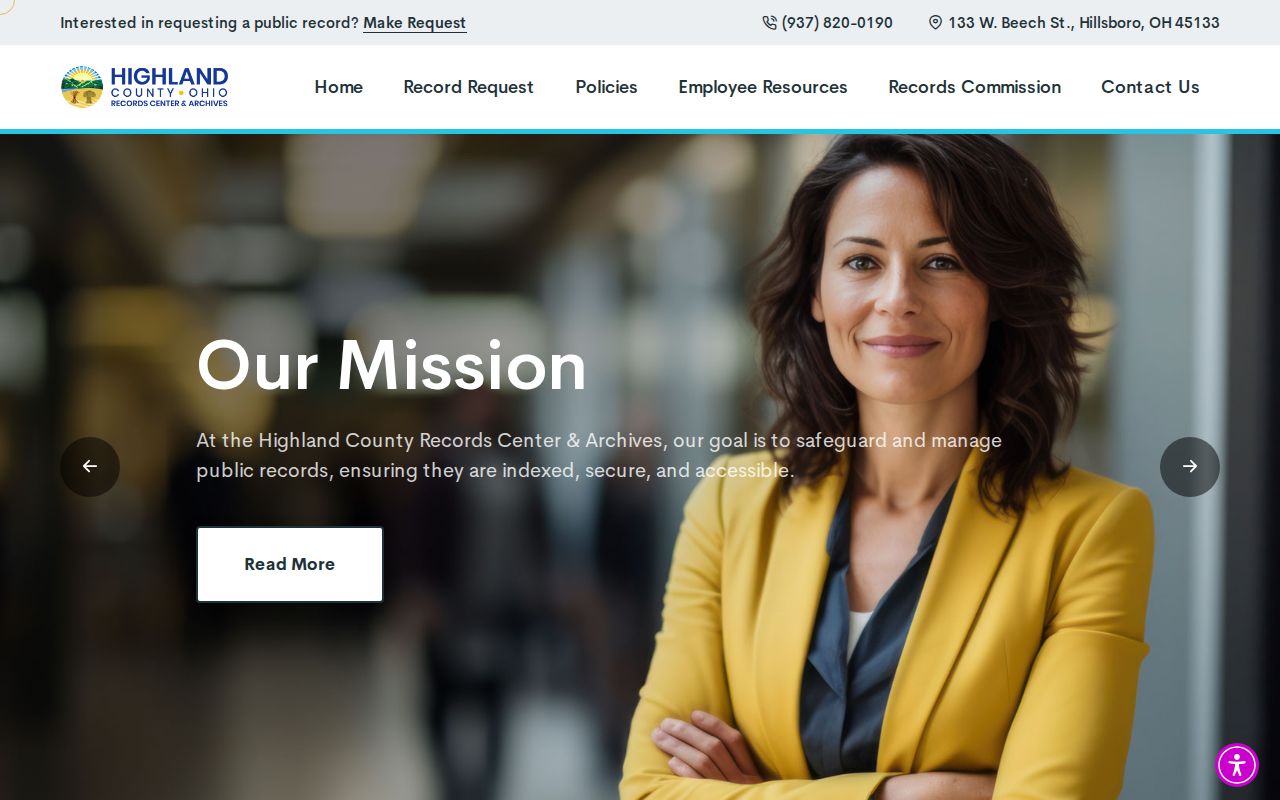
That distinction is especially useful when a roster entry is long gone but the official Highland County release record may still exist in a retained series.
Find Highland County Released Inmates
Use a custody-specific sequence. First determine whether the person is still listed at the Highland County Jail. Record the time of the check because the roster refreshes on a 30-minute cycle. Then seek positive proof of what happened. Mere absence cannot distinguish release, transfer, data delay, or a name mismatch.
- Check the Highland County current roster manually and complete its CAPTCHA. If listed, the latest feed still places the person in that jail.
- Search Ohio VINE by exact name or offender ID. Select the Highland jail result for a county stay and read the event label.
- Open the correct court docket. Use Common Pleas for felony proceedings, Hillsboro Municipal for its cases, and the Highland County Court in Greenfield when jurisdiction points there.
- Request the sheriff's booking and release record for the exact time, type, authority, and any transfer field.
- When a prison sentence appears, search ODRC by name or offender number and compare status with release detail.
- Use BOP, USMS, or ICE only when the case or hold supports a federal or immigration branch.
Why did the name disappear? The Highland County roster shows current custody, not release history. A missing name is a reason to check records, not proof of community release.
Older events call for a different order. Begin with the court case, sheriff record request, ODRC Released search, and archived county records. VINE works best before release because notification registration is prospective. In every system, match full name, date of birth when offered, offender or booking number, aliases, and case number. An arrest charge must not be restated as a conviction without the disposition.
For a narrow same-day view, the Highland County 24-Hour Release List explains how to request an existing one-day log when no public feed exists.
Highland Released Offender Search Results
The ODRC Offender Search is the official state route for a Highland County defendant who entered Ohio prison custody. Search by last name alone first, with first name as an option. An ODRC number uses an A, R, or W prefix and six digits, with a possible leading zero for some W numbers. County of Commitment can be set to Highland, but that means the sentencing county, not current residence.
| Search field | Use | Limit |
|---|---|---|
| Last and first name | Finds name and beginning-string matches. | Aliases and common names require identity checks. |
| ODRC number | Targets the state identifier. | Prefix and six-digit format matter. |
| Status | Filters Incarcerated, Released, APA Supervision, or Violators at Large. | Status wording must be read in full. |
| County of Commitment | Connects a state case to Highland County sentencing. | It is not the person's residence. |
| Residential county or ZIP | Works for APA Supervision and VAL records. | It is the last recorded address and may lag. |
| Next hearing month | Accepts YYYYMM for scheduled parole review. | A hearing date is not a release date. |
On the detail record, compare the identifier, name, sentence, docket, admission date, and offenses. A state release finding rests on the status plus the Parole or Release Detail. The Expected Release Date/Parole Eligibility Date is forward-looking and may instead mark eligibility for review. APA Supervision means prison custody ended while state supervision continues. Violator at Large describes an alleged supervision violation, not a new conviction.
The ODRC results interface displays the filters used to separate released, supervised, and incarcerated records.
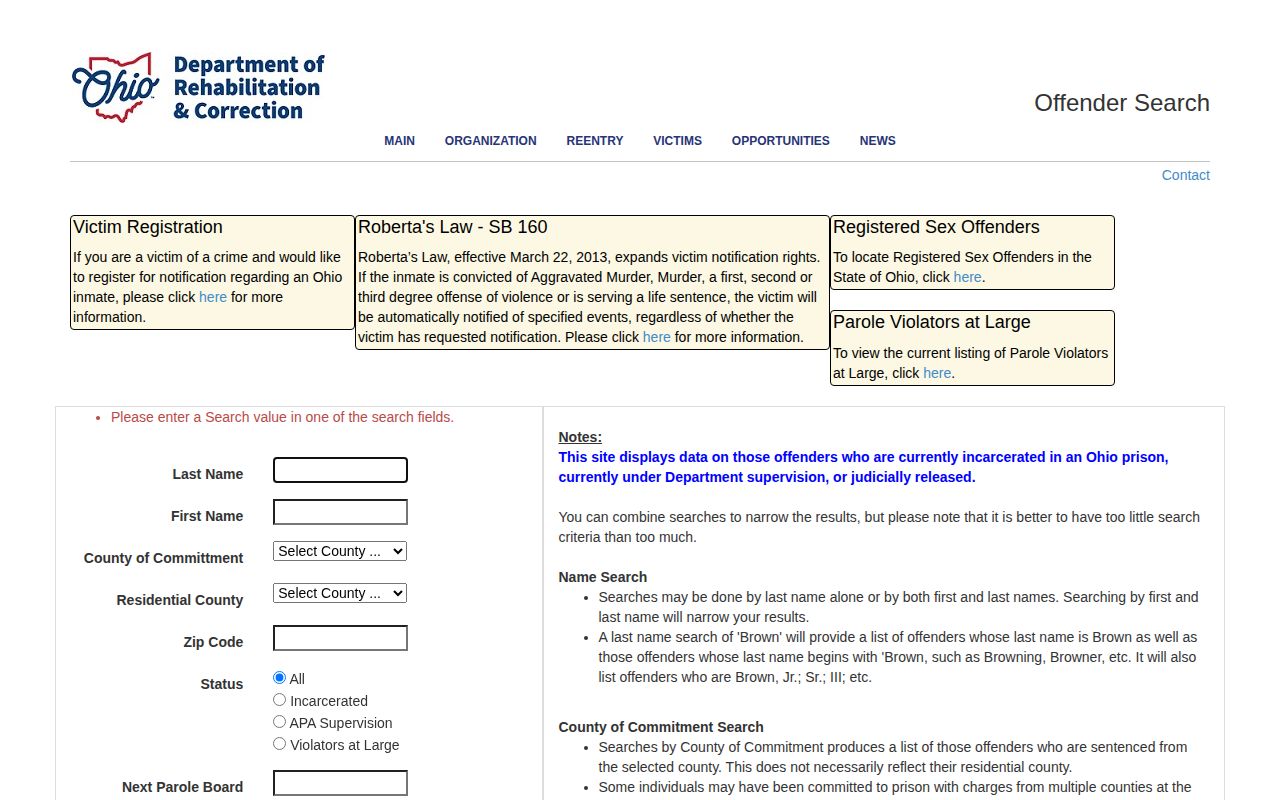
This state image applies only when ODRC received the person. A local Highland County jail stay alone will not appear there.
Highland County Release Roster Limits
Highland County does not publish an identified official recent-releases view. The Miami Valley Jails interface is titled for persons currently in custody. It provides the Highland County Jail provider name, phone, population, update frequency, and timestamp, while individual detail requires a human CAPTCHA. No public released, archive, release-date, 24-hour, or 72-hour control was found. No exact post-release display period is published.
The 30-minute rate is a current-custody refresh interval. It is not a release-publication schedule. If a person vanishes between checks, save the check times, then use VINE, court entries, and the sheriff release record. The sheriff may hold an existing daily log or export even though no public feed is posted. Ohio law does not require staff to build a custom list that does not exist.
No official Highland County sheriff mobile app for releases or mugshots was found. VINEmobile is the state VINE notification app, not a county release ledger. The sheriff's social page may carry public news, but it is not a full or systematic release record.
Note: A roster subtraction narrows the time window, while a release record establishes the actual event and its type.
Highland Release Records and Court Timing
Highland County has three court paths that can explain a local jail exit. Common Pleas handles felony cases and may show bond, dismissal, jail-time credit, sentence, community control, judicial release, or conveyance to ODRC. Hillsboro Municipal Court handles its misdemeanor docket and felony preliminary stages. Highland County Court in Greenfield is a separate lower-court path that matters when the arrest location or case jurisdiction points there.
The Common Pleas public-record gateway supplies case access, but document images are not posted online. Copies of filed journal entries can be requested from the clerk at 105 North High Street, Hillsboro, or by calling 937-393-9957. A Common Pleas prison sentence explains why a name may leave the county roster through transfer to ODRC rather than release to the community.
Hillsboro Municipal Court says its web data is current only through the prior business day and updates every 24 hours outside weekends and legal holidays. That known lag can place the physical jail event ahead of the visible docket change. A court entry proves the legal action. The Highland County jail record proves when physical discharge occurred. Use both when the distinction matters.
What if no Hillsboro case appears? Check the arresting jurisdiction and the Greenfield court path before deciding that no case exists. Similar names and posting delay can also cause a false miss.
Highland Release Alerts and Supervision
Ohio VINE covers reported custody events from participating county jails, ODRC, and the Department of Youth Services. Search by name or offender ID and select the agency-specific record. A General Release event is the key county release notice. Transfer means the person remains in custody elsewhere. Registration while the person is still held may offer phone, email, text, or TTY notice. Phone registration uses a four-digit PIN, which is entered with the pound sign to acknowledge an alert.
VINE is a notice tool, not a certified Highland County release record. A past release may no longer be easy to find. Save the event time, then confirm the type and destination with the sheriff or ODRC. The Ohio VINE line is 1-800-770-0192, and the TTY line is 1-866-847-1298. The official material says representatives are available around the clock.
Supervision also requires careful labels. Parole applies chiefly to eligible old-law, indefinite, or life sentences and is granted by the Ohio Parole Board. Post-release control follows specified prison terms. Judicial release comes from the sentencing court. Probation, often called community control in Ohio, is court ordered and may follow a local jail case without prison custody. ODRC's APA Supervision filter covers state supervision, while local probation is checked in the sentencing court and with the named probation office.
Highland Federal Release and Transfers
Federal and immigration systems are exception paths for Highland County, since no BOP prison or dedicated ICE detention center was identified within the county. Use them only when a court record, booking entry, detainer, or transfer note points there. A county roster disappearance by itself is not enough.
The BOP Inmate Locator searches federal records by BOP Register, DCDC, FBI, or INS number, or by name and identifying data. Coverage generally reaches federal inmates from 1982 onward. A past release date with Released or Not in BOP Custody means the person is no longer held by BOP. It does not rule out federal supervision, state custody, immigration custody, or another authority. In Transit is also not final discharge.
Pretrial federal detainees are generally under the U.S. Marshals Service, which has no equivalent broad historical public release-name locator. Use the federal docket and responsible district contact when a Highland record shows a USMS hold. For an immigration transfer, the ICE detainee locator accepts a nine-digit A-number with country of birth or exact biographical details. A miss can result from spelling, timing, age limits, transfer, release, or data limits. It does not prove community release.
Highland Release and Custody Sources
Choose the source by custody type and the fact that needs proof. No single Highland County lookup covers county jail, state prison, federal custody, immigration transfer, the legal case, and later supervision.
- Highland jail roster
- Covers people currently held locally and proves only a listing at the stated update time.
- Sheriff release record
- Covers a named county-jail booking and best proves local release time, type, authority, and maintained transfer fields.
- Local court docket
- Covers the criminal case and explains bond, dismissal, sentence, prison orders, or supervision decisions.
- ODRC Offender Search
- Covers state prisoners, released records, APA supervision, and VAL records with state status and release detail.
- Ohio VINE
- Covers reported Ohio custody events and provides prospective notice of a general release, transfer, or other event.
- BOP or ICE locator
- Covers the supported federal or immigration branch within each system's limits.
A sex-offender registry is narrower still. It applies only to people with an Ohio registration duty. It may show a reported address or registration status after custody, but it is not a Highland County released-inmate list and does not establish a jail release time.
Highland Release Facility Names
The sheriff calls the local operation the Highland County Justice Center. The linked regional roster calls the provider Highland County Jail. These are not two separate local jails in the researched release path. The sheriff's Corrections Division page links directly to the regional provider, tying both names to the same county custody channel at the Homestead Drive complex.
This naming difference affects searches. A court order or VINE record may use one form while a sheriff page uses the other. Match the person, agency, booking, and date before deciding records concern different facilities. For formal requests, naming both Highland County Justice Center and Highland County Jail can help staff identify the requested record series.
Highland County Release Facilities
The facility map includes the local jail plus systems that may receive a Highland County person. Only the Justice Center is the county jail. The other pages explain statewide or federal release routes and the short-term Hillsboro court holding process.
- Highland County Justice Center: county custody may end in community release or transfer, confirmed through the sheriff record, VINE, and court.
- Ohio Department of Rehabilitation and Correction Institutions: a Highland felony commitment is searched statewide because no adult ODRC prison was found in the county.
- Federal Bureau of Prisons Institutions: BOP records apply after federal commitment, while USMS handles the pretrial branch.
- Immigration Detention System: ICE becomes relevant only when a supported detainer or transfer points to immigration custody.
- Hillsboro Municipal Court Holding Process: the court docket may show bond or disposition, while the jail keeps the physical release record.
Each custody route must be checked on its own terms so a Highland County jail transfer is not misreported as release to the community.